


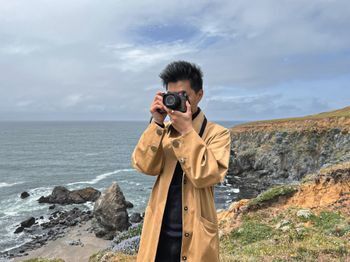
Biographical Information:
“I am not interested in what is perfect.
I am interested in what is.”
— Tommy Lei
Tommy Lei (b. 1988, Hong Kong) is a Los Angeles–based visual artist whose photographic work investigates stillness, perception, and impermanence. Working with archival pigment prints across wood, acrylic, and aluminum, Lei distills natural
and urban landscapes into contemplative visual fields that heighten awareness of light, space, and presence.
Informed by a bicultural upbringing, his practice bridges Eastern philosophy and Western minimalism, exploring fragility, resilience, and the subtle emotional architecture of lived environments. His acclaimed series Infrared Dreams reconfigures familiar flora and terrain through custom infrared processes, revealing spectral dimensions that challenge conventional sight and reframe the act of looking.
Restrained and deliberate, Lei’s compositions favor clarity over spectacle, offering work that is meditative yet structurally precise. Rather than document the world, he reframes it—creating images that function as both visual inquiry and quiet refuge.
Lei holds a degree from Cornell University. His work has been exhibited at the Pasadena Museum of History, is held in the JPMorgan Chase Art Collection, and has been featured in Architizer, Aesthetica Magazine, and The Washington Post. He is a part of LACP (Los Angeles Center of Photography), Arroyo Arts Collective and serves as a Canson Infinity Ambassador.
Artist Statement:
“I am not interested in what is perfect.
I am interested in what is.”
My work begins with observation. I am drawn to environments that are easily overlooked—fog settling over water, winter light flattening a facade, foliage suspended in stillness. These moments are not dramatic. They are honest. Through photography, I reduce the landscape to its essential elements: light, structure, and atmosphere. By removing excess visual noise, I invite viewers to confront presence itself—what remains when distraction falls away. Influenced by Eastern philosophies of impermanence and Western minimalism, I approach the image as both document and meditation.
In Infrared Dreams, I extend this inquiry by using custom infrared processes to destabilize familiar terrain. Vegetation becomes luminous and spectral, disrupting habitual perception and asking the viewer to reconsider what is seen versus what is assumed. The work is not about spectacle, but about recalibration.
Across my practice, I am interested in fragility and resilience—the quiet tension held within physical spaces and within ourselves. The final works function as contemplative fields: restrained, deliberate, and spatially aware. They are not meant to overwhelm a room, but to alter the way one occupies it.
I am not searching for perfection in the landscape.
I am searching for presence.
